Background
A nearby weather station reported 76 mm of precipitation in the last 24 hours. The avalanche danger level was 3 (considerable), with the main problem being a weak layer of new snow above 600 masl in N, E, and S aspects.
The group consisted of 2 athletes, 1 cameraman, 1 director, 1 intern, and 1 guide.
Earlier that day, the group had been skiing and filming in NW- and W-facing terrain with significant amounts of new snow. The group have been out skiing together 2 days before this too, parts of the group new each other from before.
Incident description
On the way back, the guide decided to hike slightly higher to gain more speed for a long, flat section in the forest. The group consisted of both skiers and snowboarders, and there was concern about maintaining enough speed to exit the valley efficiently.
The plan was also to capture some final close-up powder shots on a short, steeper section before returning to the van and wrapping up the day. This was the third consecutive day the group had been skiing together. Some members knew each other from before, while others did not.
Below the steeper face, there was a plateau intended as a regrouping point before exiting via the safest route. One location, marked by a bush, was identified as a safe spot. Below the plateau, the terrain steepened significantly into cliffs.
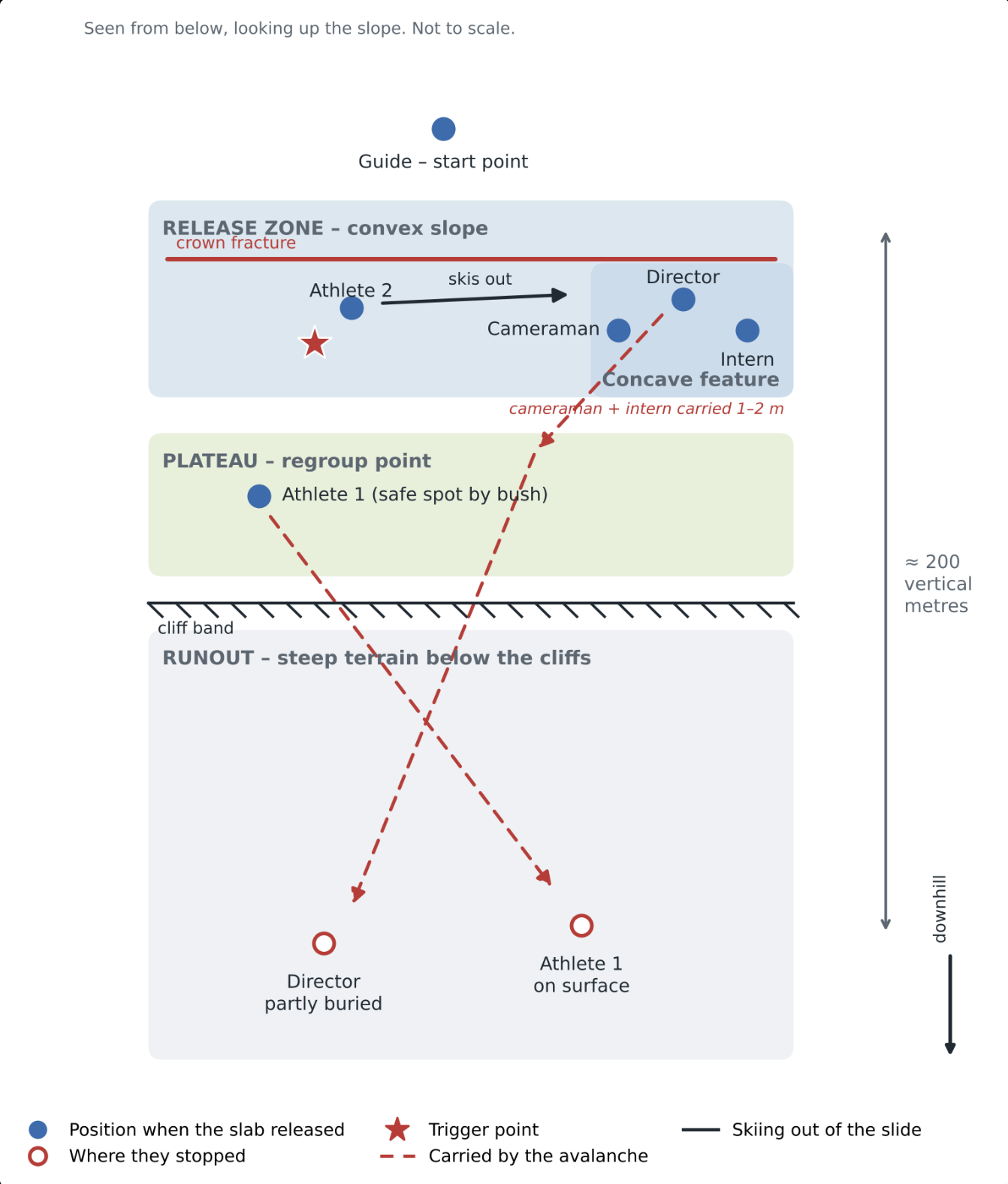
Figure 1. Where everyone stood when the slab released, and where the director and Athlete 1 stopped. Seen from below, not to scale.
The director first skied down to the left side of the slope, in a concave feature. The cameraman followed to find a suitable filming position. The intern then skied down to skier’s left of the director and cameraman.
Athlete 1 descended next, skiing the steeper convex part of the slope, making several deep turns in front of the camera, and continued down to the designated safe spot by the bushes.
Athlete 2 then skied the slope, slightly to the side of Athlete 1’s line. After a few turns, an avalanche was triggered. The crown propagated upward toward the media team. Athlete 2 managed to ski out of the avalanche to the left.
The intern and cameraman had the crown fracture approximately one meter above them and were carried 1–2 meters before stopping. The director moved left toward the center of the avalanche path and was caught.
As the avalanche moved over the plateau, it slowed down but continued toward Athlete 1, who was positioned at the safe spot. Both the director and Athlete 1 were eventually carried over the edge and down the steeper terrain below.
When the slab passed over the plateau, it entrained loose snow further downslope. There was no slab or crown in this section, only loose snow movement.
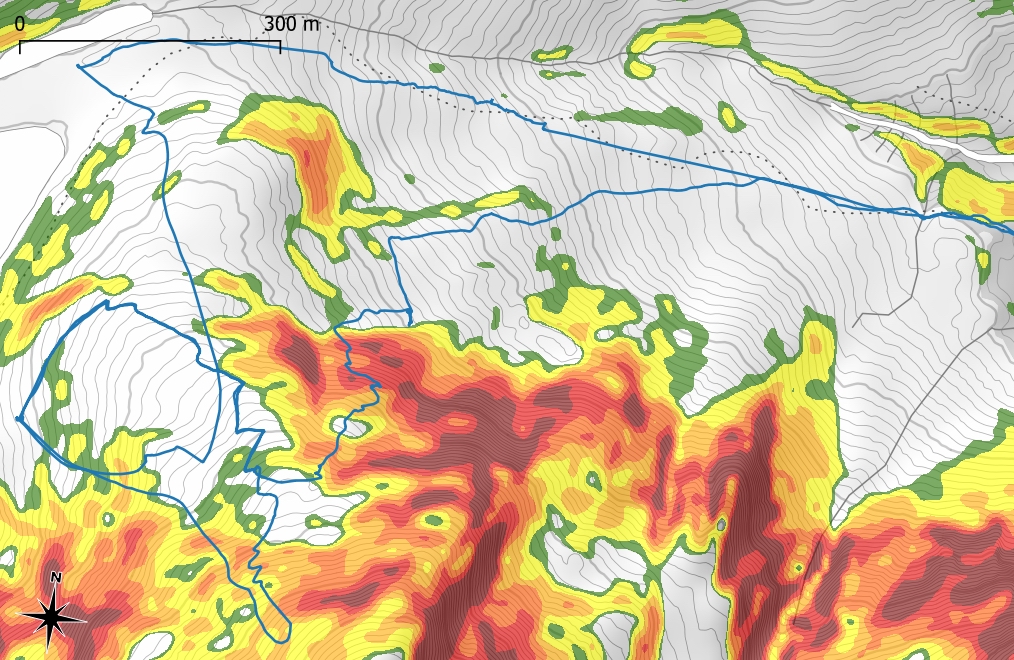
Figure 2. Overview of the day's GPS tracks (blue) on a slope steepness map. Colours: green 27–30°, yellow 30–35°, orange 35–40°, red 40–50°, dark red over 50°. [Map source]
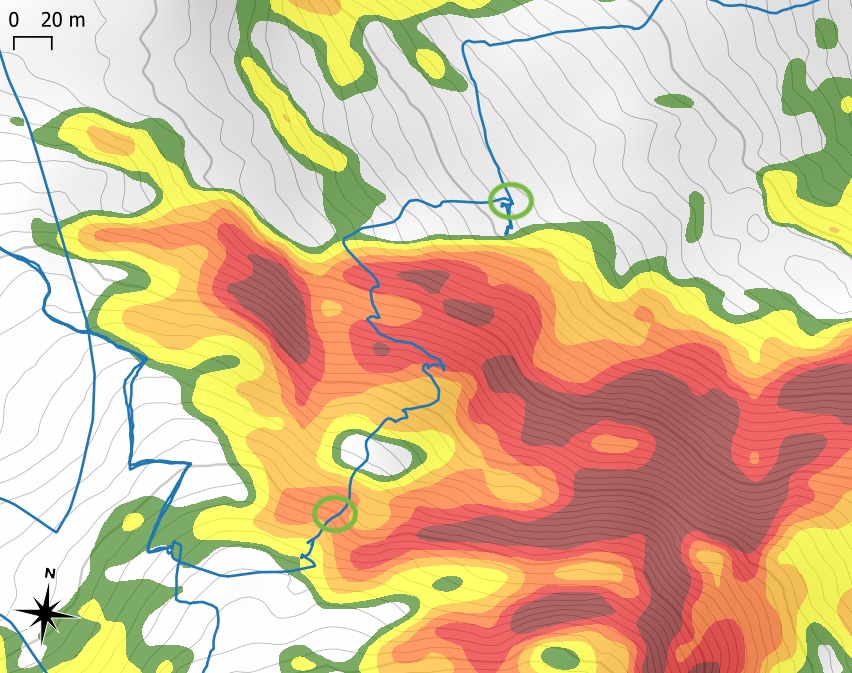
Figure 3. Detail of the avalanche slope. Green circles: [upper = release, lower = End point of taken person].
Rescue
The guide instructed everyone to switch their transceivers to search mode and skied down to the plateau. Athlete 2 and the intern joined the signal search. At this point, neither of the two buried individuals was visible.
After approximately 15 seconds, the guide and Athlete 2 visually located both individuals. Athlete 1 was on the surface, and the director was partially buried but responsive.
The guide communicated to the group that both individuals had been found. Athlete 2 skied down quickly to assist Athlete 1 in digging out the director. Due to the steep terrain, the guide decided to safely guide the cameraman and intern down to avoid further exposure.
The group regrouped at the director’s location and conducted a full check to confirm that no one was injured. The only physical losses were one ski and a pair of poles.
The total time from the start of the search until everyone was safely at the bottom was approximately 6 minutes.
Context
In film productions like this, there is often a higher acceptance of risk, both in terrain choice and how the group moves within it.
In a guided setting, it would not be acceptable to have multiple people exposed in the slope simultaneously while others are skiing. However, this is sometimes necessary to capture the desired footage. Similarly, the terrain skied in film productions often exceeds what would be appropriate for guided clients.
At the same time, it is important to remain transparent about the inherent risks of off-piste skiing. While guides can reduce risk significantly, it can never be eliminated entirely. It is also important to recognize that risks are not limited to avalanches—other types of injuries are more frequent.
The group had relevant information about the unstable snowpack but still ended up in this terrain. This raises important questions about decision-making.