





Avalanches, Weather and Wind – How to Understand Mountain Hazards
Knowing how snow, weather, and terrain interact is the foundation of avalanche awareness. Below you’ll find a summary of the main avalanche types, the conditions that increase or decrease risk, and typical terrain traps to avoid.
Two main types of avalanches
Loose snow avalanches
Loose snow avalanches occur when the surface snow has poor friction with the underlying layer. The avalanche starts at a single point and grows as it entrains more snow—like a snowball rolling downhill. It often forms a distinct pear-shaped debris cone.
Although loose snow avalanches are rarely the most dangerous for skiers, they can still cause a fall—something that can have serious consequences in steep terrain, near cliffs, or in forested areas.
Slab avalanche
Slab avalanches are the type most often involved in accidents and the one you should be most aware of. For a slab avalanche to occur, three elements need to be present:
- A sliding surface – a hard, smooth layer, often icy
- A weak layer – softer snow, often surface hoar, facets, or depth hoar
- The slab itself – a cohesive layer of snow, often wind-transported and compacted
Slab avalanches can be triggered naturally or by skiers—and even remotely from a distance.
Weather Conditions
Favourable Conditions
- Little or no wind
- Temperatures just below 0 °C
- Rain turning into snow (creates strong bonding to the old snow surface)
Unfavourable Conditions
- Strong wind
- Large amounts of new snow
- Very low temperatures
- Clear layering in the snowpack, especially multiple crust layers
Wind – the architect of avalanches
Wind is often the single most important factor in avalanche formation. It can move large amounts of snow quickly and create slabs that are easy to trigger. When the wind picks up, avalanche danger can increase rapidly.
Avalanche forecasts often refer to lee areas—terrain features that collect snow. If the wind blows from the west, slopes and features facing east collect the most snow. These are usually the most avalanche-prone.
Avoid travelling in lee terrain after wind and snowfall. Choose wind-scoured ridges or elevated terrain instead.
Terrain features to avoid: gullies, couloirs, creek beds, and depressions.
Heavy snowfall
A day with intense snowfall often provides great skiing—but also a rapid increase in avalanche danger. If the snowpack does not contain persistent weak layers, the risk may decrease again after some time, but the first hours after heavy snowfall require extra caution.
Slope angle – where avalanches occur
Most avalanches release on slopes between 30° and 45°.
- Below 30° → unlikely for a slab to release
- Above 45° → snow usually sluffs naturally throughout the winter
- The majority of skier-triggered avalanches occur between 36° and 38°
Aspect – the effect of sun and temperature
How much sunlight a slope receives affects both stability and snow quality.
North-facing slopes
- Often more avalanche-prone because weak layers remain preserved for longer
- Powder snow usually stays cold and dry here
South-facing slopes
- More sun leads to a more uniform and often more stable snowpack through winter
- However: during warm spring days, wet avalanches are most common on sun-exposed slopes
Terrain traps
A terrain trap is a feature that increases the consequences of even a small avalanche. Always avoid:
- Creek beds and gullies
- Cliffs
- Cornices
- Rocks and dense birch forest
- Tight, steep forest
An avalanche that would otherwise be small can become life-threatening if it carries you into a terrain trap.
Summary
Avalanche danger is the result of the interaction between snow, weather, and terrain. When you understand how wind, new snow, weak layers, and terrain features influence one another, you are far better equipped to make safe decisions in winter mountains.
Choose safer terrain, continuously evaluate the conditions, and adapt your tour to the situation and your skill level. Even with good knowledge and advice, we strongly recommend taking an avalanche course or travelling with a qualified guide when entering avalanche terrain.
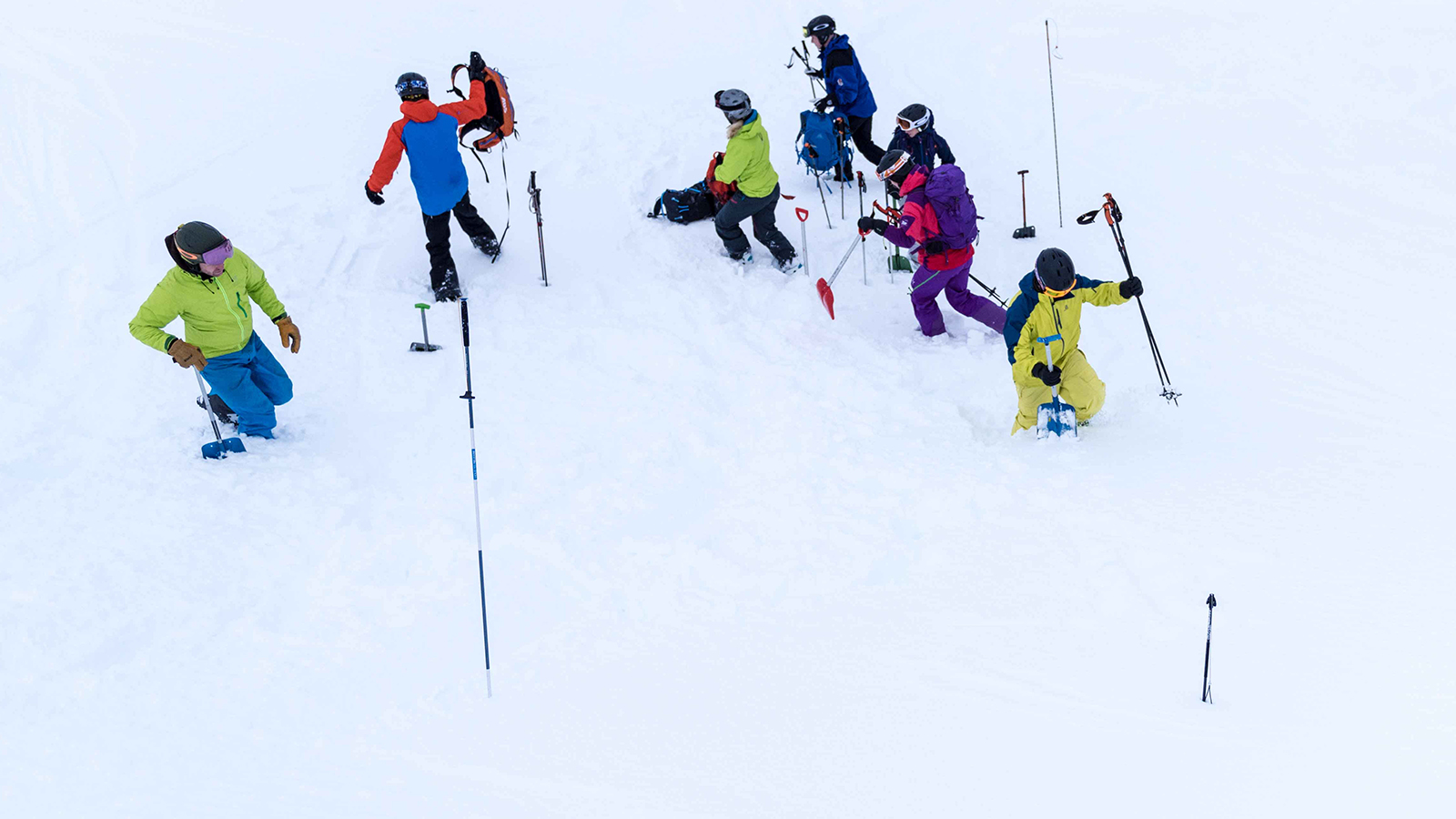
Check out our avalanche courses below.